Buyer's Guides
Bouquet Wrapping Paper Materials Explained
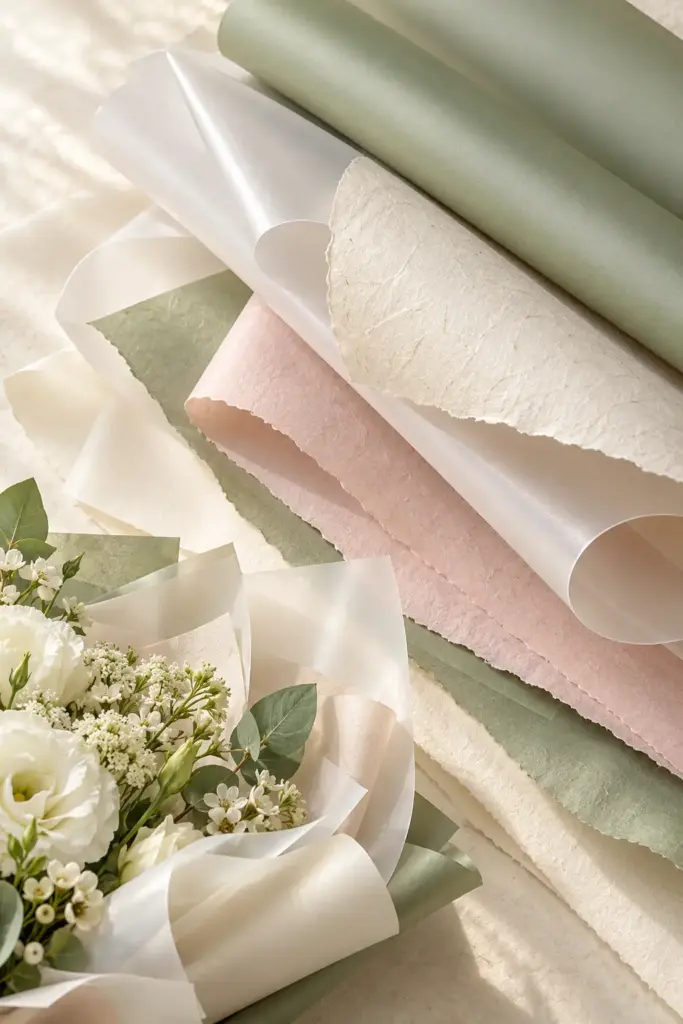
Oct
Last updated:
What paper do florists use to wrap bouquets? The short answer is that there is no single paper: florists use sheets, tissue, mesh, OPP film, kraft and printed designs, and the right choice depends on three things — how wet the stems are, how much structure the bouquet needs, and what look the occasion calls for. WrapStoria’s wrapping-paper range reflects that spread: the category itself describes “water-resistant kraft, tissue, and printed designs in bulk rolls and sheets,” and the bulk of the range is sheet paper in sizes from 35 × 50 cm up to 60 × 60 cm, sold mostly in bags of 20 sheets. This guide maps each material to its behaviour so you can choose from a listing without guessing.
What the range actually contains
| Material or form | What it is | Water behaviour | Stiffness and drape | Best bouquet fit |
|---|---|---|---|---|
| Standard sheets | Printed or solid paper sheets, the bulk of the range | Absorbs water; keep stems dry or add a liner | Holds a wrap shape well, folds cleanly | Everyday handheld bouquets, the default choice |
| Tissue | Soft, lightweight layering paper | Absorbs water fast; no protection on its own | Very soft, no structure | Softening layer inside a sturdier sheet |
| Mesh | Open-weave netting, sold by width and length | Open weave ventilates; does not hold water | Textured, stands away from the stems | Decorative accent and texture over a base wrap |
| OPP film | Clear plastic film, sold by width and length | Waterproof barrier | Smooth, clings to the bouquet | Inner liner for wet stems, under any outer paper |
| Kraft | Uncoated natural paper, printed or plain | Absorbs water; not waterproof | Sturdy, crisp folds, rustic look | Natural and rustic designs, with a liner for wet stems |
| Printed designs | Patterned sheets in the same sizes as standard sheets | Same as the base paper; check the listing | Same as standard sheets | Occasions where the wrap is part of the look |
| Ready-made bags | Pre-shaped bags with gusset sizes, sold by pieces | Depends on the bag material; check the listing | Quick to use, fixed shape | Fast shop service and uniform presentation |
Two cautions on names. First, material words on listings are specific: only some listings name a material, and the verified material names in this range are Mesh, Korean Matte, Korean, OPP and Tissue. If a listing does not name a material, judge it by its size, pack and description rather than assuming one. Second, sizes are the reliable comparison: the most stocked sheet sizes are 58 × 58 cm, 56 × 56 cm, 57 × 57 cm and 50 × 70 cm, and the most common pack is 20 sheets per bag. Real listings to compare include wholesale florist wrapping paper 56 56 cm 20 sheets, wholesale mesh florist wrapping paper 20 cm 2.5 meters and wholesale tissue florist wrapping paper 50 70 cm 20 sheets.
Why water behaviour matters most
Stems are wet, paper is not. That single fact drives most wrapping mistakes. Standard paper, tissue and kraft all absorb water, so a bouquet wrapped in them and then stood in water, or carried in rain, will show damp marks and weaken at the folds. Water-resistant is not waterproof: a water-resistant design sheds light dampness, but it will still soak through if stems stay wet against it. The reliable fix is a liner: a waterproof inner layer, such as OPP film, between wet stems and the outer paper. Choose the outer paper for the look, and let the liner do the waterproofing. Never rely on the outer paper alone to protect wet stems.
When to choose which
- Everyday shop wrap: standard sheets. They are the most stocked, the easiest to fold, and the cheapest to keep in depth across sizes.
- Wedding or luxury bouquets: layering. Tissue inside for softness, a standard sheet or kraft outside for structure and presentation.
- Wet stems or delivery: OPP liner plus any outer paper. The liner handles the water; the outer paper handles the look.
- Texture and accent: mesh over a base wrap. It adds visual interest without adding weight, but it is not full coverage on its own.
- Fast service: ready-made bags. Pre-shaped and quick, at the cost of a fixed look.
How to choose in six steps
- Decide wet or dry stems. If stems will stay wet, plan a liner first and choose the outer paper second.
- Pick the look. Matte or printed, natural kraft or soft tissue, and whether the wrap should be part of the presentation or disappear behind the flowers.
- Pick the form. Sheets for hand wrapping, rolls for high volume or long lengths, bags for speed.
- Match the size. The sheet must go around the bouquet with overlap for folding. Standard handheld bouquets suit 56 × 56 cm or 58 × 58 cm; small posies suit 35 × 50 cm.
- Do the pack math. Divide the sheets you need by sheets per bag and round up. The most common pack is 20 sheets, but listings also come in 5, 10, 15 and 50 sheets, so read the pack before you calculate.
- Sample before bulk. Order a sample first to check feel, colour and fold in hand. Samples are exempt from the minimum order, while standard orders start at MOQ from 20, with the unit (bags, rolls, or as listed) following the listing.
Frequently asked questions
Is all wrapping paper waterproof?
No. Only specific waterproof or water-resistant designs resist water, and even water-resistant designs are not fully waterproof. Standard paper, tissue and kraft absorb water. If stems will be wet, use a waterproof liner and check the listing’s material description before ordering.
Can tissue paper wrap a bouquet on its own?
For a light posy, yes, but tissue is soft and tears easily. For a standard handheld bouquet, use tissue as a layer inside a sturdier sheet rather than as the only wrap.
Is mesh a full wrap?
No. Mesh is an open weave: it adds texture and ventilation but does not cover the bouquet the way a solid sheet does. Use it over a base wrap when you want the textured look.
Is kraft paper the cheapest option because it looks plain?
Do not assume that. Price depends on size, pack and material, and WrapStoria prices by tier per order, with freight quoted separately. Compare listings on size and pack rather than judging cost from appearance.
What size sheet do I need?
It depends on the bouquet’s diameter: the sheet must wrap around it with enough left over to fold. As a starting point, 56 × 56 cm or 58 × 58 cm suits a standard handheld bouquet, and 35 × 50 cm suits a small posy. Measure your bouquet before ordering.
Can I order one bag to test?
Standard orders start at MOQ from 20, with the unit following the listing (bags, rolls, or as listed). For testing, request a sample first: samples are exempt from the minimum order.
